
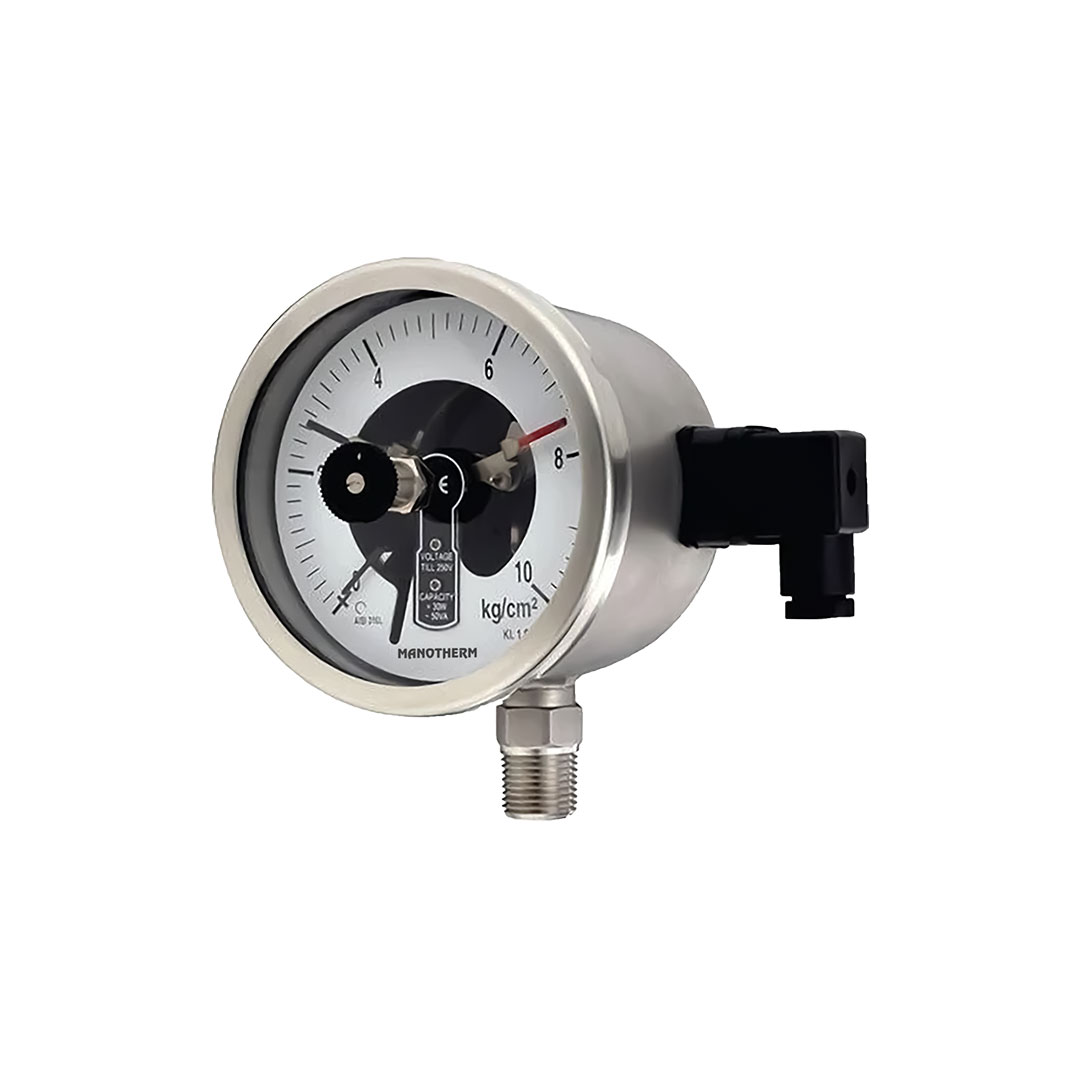

Description
1. Introduction to Contact Pressure Gauge MT-P100EC
The Contact Pressure Gauge MT-P100EC is a high-performance pressure measuring instrument specifically engineered for control, monitoring, and automation systems where precise pressure measurement must be accompanied by switching or contact output signals. These gauges are equipped with electrical contacts that allow them to operate alarms, relays, control circuits, and shutoff valves when the system pressure reaches a preset value. This makes them a critical component in process control and safety systems across various industrial environments.
Designed to withstand the severest ambient and process conditions, the MT-P100EC delivers reliable performance even in highly demanding installations. It is suitable for Oil & Gas, Petrochemical, Chemical, Power & Utilities, Machinery Building, and General Industrial Process environments where durable construction and dependable switching response are essential.
2. Key Features of Contact Pressure Gauge MT-P100EC
The Contact Pressure Gauge MT-P100EC incorporates an advanced mechanical structure combined with electrical switching functionality to deliver both precise pressure reading and system control capability. Key features include:
-
Designed to withstand severe operating conditions
Suitable for harsh industrial environments involving vibration, pressure fluctuations, and temperature extremes. -
Reliable for chemical and petrochemical applications
The use of high-grade materials makes the gauge compatible with corrosive media and atmospheres. -
Suitable for Oil & Gas Industry
Provides dependable safety and control monitoring in production, refining, and transportation systems. -
Applicable in utilities and power plants
Ideal for monitoring pressure of steam, feedwater, compressed air systems, and cooling circuits. -
Used in machinery building
Supports automation in compressors, hydraulic systems, and engineered equipment. -
Widely applied in general process industries
Offers universal pressure monitoring and switching capability.
The combination of mechanical durability and electrical contact switching makes the MT-P100EC a high-value solution for controlling operations based on real-time pressure behavior.
3. Standard Parameters and Performance Capabilities
The Contact Pressure Gauge MT-P100EC is available in different accuracy classes and dial configurations depending on customer requirements and system sensitivity.
Ambient Temperature:
-
Filled gauge: -20°C to +60°C
-
Dry gauge: -40°C to +60°C
Medium Temperature:
-
Filled gauge: -20°C to +90°C
-
Dry gauge: -40°C to +200°C
These temperature ranges ensure excellent adaptability for both high-temperature industrial media and outdoor ambient conditions.
Pressure Limits:
-
Steady pressure: up to full scale (FS)
-
Fluctuating pressure: up to 90% of FS
-
Short-time pressure: up to 1.3 × FS
This wide pressure tolerance ensures stable performance even under pulsating process conditions.
4. Construction Materials
The MT-P100EC is built from high-strength, corrosion-resistant materials to maximize operating life in demanding process environments.
CONSTRUCTION OF MATERIAL:
| Component | Material |
|---|---|
| Bezel & Case | AISI 304 / AISI 316 Stainless Steel |
| Process Connection | Alloy 400 / AISI 316 Stainless Steel* |
| Sensing Element (Bourdon Tube) | Alloy 400 / AISI 316 Stainless Steel* |
| Internal Movement | Stainless Steel |
| Dial & Pointer | Aluminum |
| Window / Gasket / Blowout Plug | NBR (HNBR for filled gauges) |
| Window Option | Acrylic |
| Mounting Flanges | AISI 304 / AISI 316 Stainless Steel |
| Terminal Box | Polyamide 6 |
These construction features provide strong resistance against pressure cycling, corrosion, and vibration, helping ensure long service life and stable output performance.
5. Operating Principle
The Contact Pressure Gauge MT-P100EC functions by converting process pressure into mechanical displacement, which is then used to trigger electrical contact mechanisms. As pressure increases inside the sensing element (typically a Bourdon tube), mechanical motion is transmitted through the movement system to the dial pointer. Mounted on the pointer shaft are adjustable electrical contacts. When the pointer reaches the preset switch point, the electrical contact closes or opens, enabling control signals to be sent to external devices.
This setup allows:
-
Pressure-triggered alarms
-
Automatic pump or valve actuation
-
System pressure protection shutdown
-
Multi-stage control when using dual-contact models
The switching action is direct, instantaneous, and does not require external power, making it reliable even in critical safety loops.
6. Typical Applications of Contact Pressure Gauge MT-P100EC
The MT-P100EC is used across many industrial processes, including:
-
Oil & Gas production and transport pipelines
-
Petrochemical reactors and utility supply lines
-
Chemical dosing and reactor pressure monitoring
-
Power plant steam and cooling systems
-
Compressor and hydraulic skid pressure control
-
Boilers and furnace control loops
-
Water treatment and filtration plants
Wherever pressure needs to be monitored and controlled simultaneously, this gauge provides a robust and efficient solution.
7. Advantages of Using Contact Pressure Gauge MT-P100EC
-
Reduces need for separate pressure switches
-
Simplifies instrumentation and wiring
-
Provides reliable safety shutdown control
-
Operates without external power
-
High corrosion and temperature resistance
-
Stable long-term accuracy
-
Suitable for continuous industrial operation
These advantages contribute to lower maintenance costs, enhanced system safety, and improved operational efficiency.
8. Conclusion
The Contact Pressure Gauge MT-P100EC is a powerful and reliable instrument that combines precise pressure monitoring with integrated electrical contact control. Designed for harsh industrial environments, it offers durability, accuracy, and dependable switching performance—making it ideal for process control, safety systems, and automated operations across multiple industries.